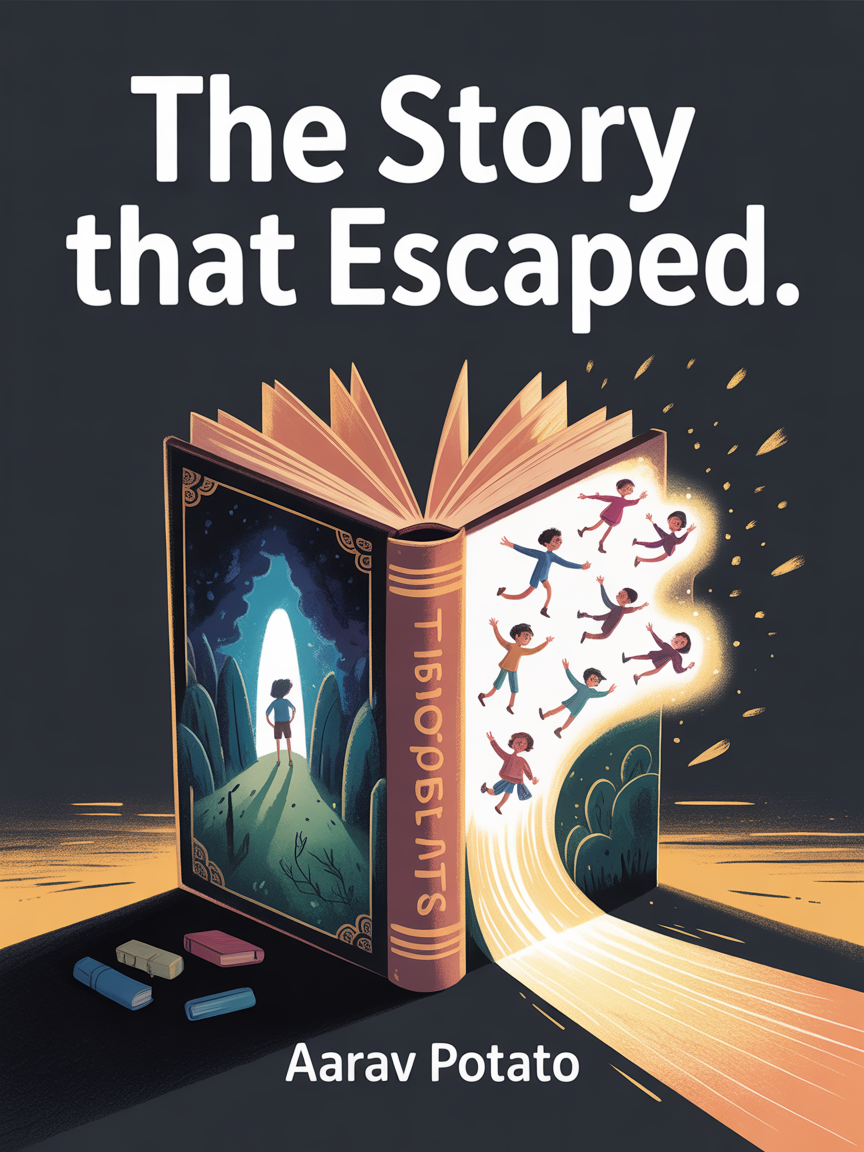
A flipbook version of Aarav's story
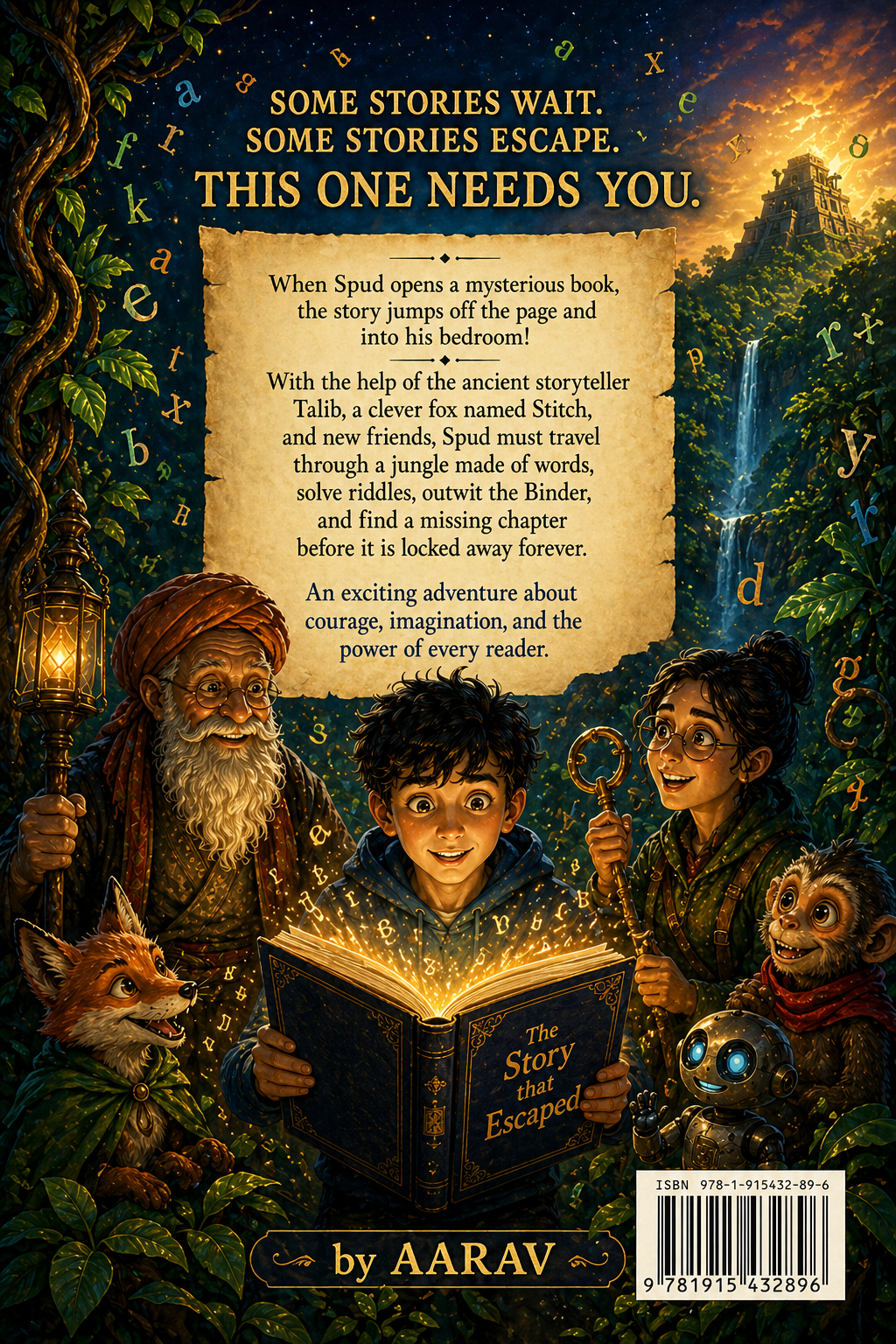
Spud was meant to be asleep.
His bedroom lamp was off, the curtains were half-closed, and the house had gone quiet in that deep, late-night way when every small sound seemed louder than it should. But under his duvet, with a torch balanced on his chest, Spud was reading a hardback book he had found that afternoon in a second-hand shop. It had no picture on the cover, only a title stamped in silver letters: The Story That Escaped.
He had bought it because the title felt like a dare.
At first, it seemed like a normal book. It opened with an old storyteller in a long blue robe sitting by a fire, speaking to an unseen crowd. But after a few pages, Spud noticed something odd. The words were shifting. Not much. Just a letter here, a space there. Then a sentence wriggled across the page like a worm and disappeared into the fold of the book.
Spud sat up.
“Very rude,” said a voice.
A man was standing at the foot of his bed.
Spud nearly dropped the torch. The man looked exactly like the storyteller from the first page. He had a lined face, bright eyes, and a robe patterned with tiny gold symbols. A smell of smoke and rain clung to him, as if he had walked out of an ancient campfire and straight into a modern bedroom.
“You’re real,” Spud whispered.
The storyteller gave a small bow. “I am called Talib, Keeper of Tales, Chaser of Beginnings, and on one unfortunate occasion, owner of a goat who ate a prophecy.”
Spud blinked. “Right.”
Talib looked towards the book. Its pages were fluttering by themselves now. Loose words drifted out of it like moths and hovered in the air above the duvet.
“We have a problem,” Talib said. “A chapter has gone missing. Without it, the story cannot stay in its proper shape. When stories lose their shape, they escape.”
As if to prove his point, the bedroom wall beside Spud’s desk rippled like water. The pale paint dissolved, replaced by thick vines made from curling letters. Leaves unfolded, each one printed with tiny lines of text. Beyond them stretched a jungle, deep and green and full of moving words.
Spud stared. “My wall has turned into a book.”
“Into part of one,” Talib corrected. “Will you help me?”
Spud looked at the ordinary things in his room: his trainers, his school bag, the socks he had forgotten to put away. Then he looked at the impossible jungle pushing into his bedroom.
“Yes,” he said at once.
Talib smiled. “Good. Bring your torch. In story jungles, light is often useful.”
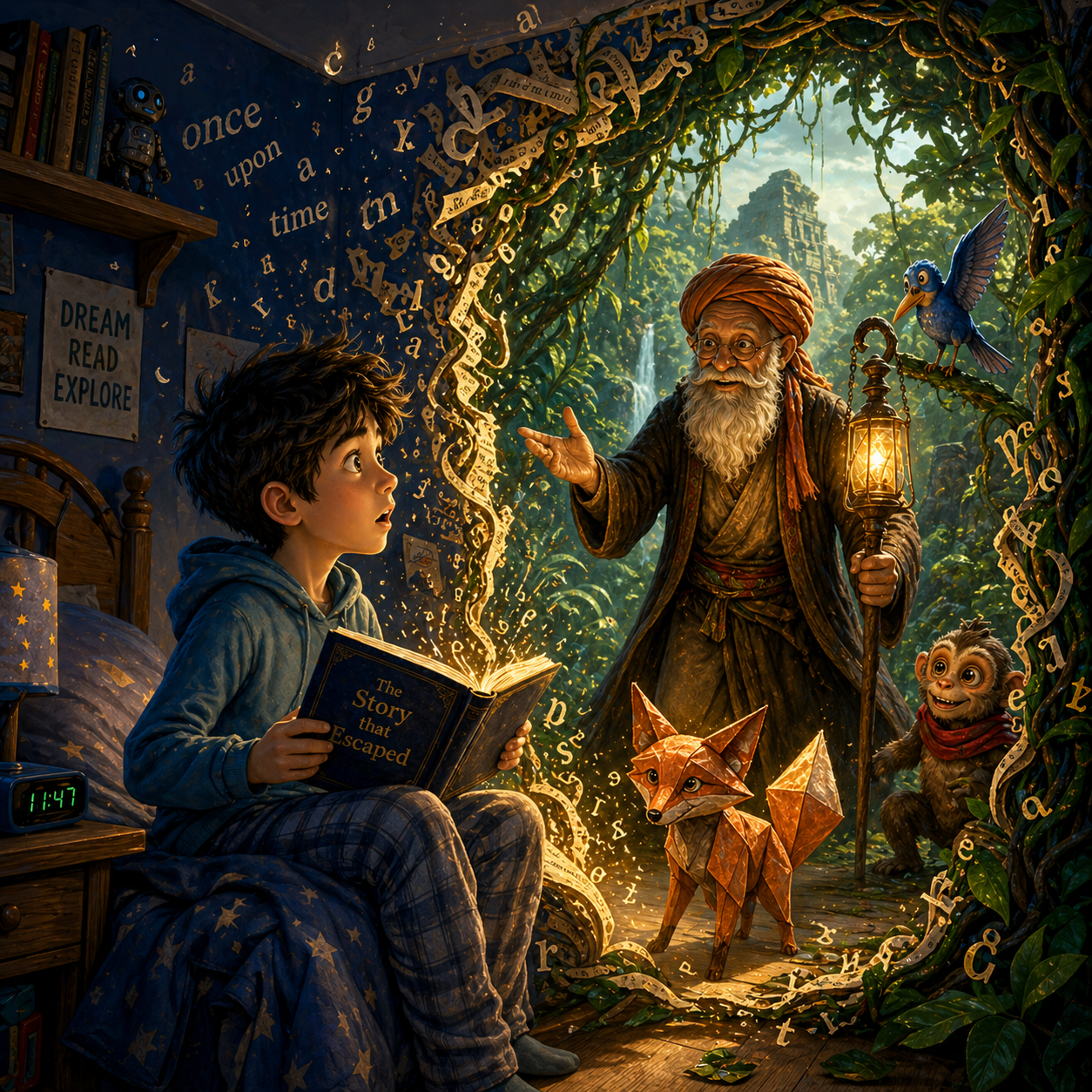
They stepped through the opening.
The jungle floor was soft with scraps of paper instead of soil. Enormous tree trunks rose up around them, their bark covered in neat black sentences. Strange bright birds with comma-shaped tails swooped between the branches. A fox made of folded pages trotted out from behind a bush and sat neatly in front of them.
“This is Stitch,” Talib said. “He belongs to no one, steals from everyone, and occasionally has excellent ideas.”
The paper fox dipped his head as if accepting praise.
From somewhere nearby came a crashing sound, followed by an irritated voice. A woman in a green coat pushed through a curtain of hanging vines. She wore round spectacles and carried a net on a long pole.
“Talib!” she snapped. “Do you know what your loose adjectives have done to the river?”
Talib winced. “Miss Quill. What a pleasure.”
“It is not a pleasure. The water has started describing itself.”
Miss Quill turned to Spud. “And who is this?”
“Spud,” he said.
“A reader?” she asked.
“I think so.”
“Excellent. Readers are often useful in emergencies.” She lowered her voice. “The missing chapter is being hunted by the Binder.”
Spud frowned. “The Binder?”
Talib’s face darkened. “A collector. He believes stories should be sealed, sorted, and never changed. He hates surprises, imagination, and muddy footprints on important pages.”
Miss Quill adjusted her spectacles. “He has taken over the Iron Library at the heart of the jungle. If he finds the lost chapter first, he’ll lock it away forever.”
Spud tightened his grip on the torch. “Then we need to get there first.”
Miss Quill nodded. “You’ll have to cross the Whispering Canopy, answer the riddles at the Rhyme Gate, and pass through the Valley of Erased Things. Nothing difficult if you enjoy danger.”
“I don’t,” said Spud.
“Pity,” said Miss Quill. “Off you go.”
The path climbed steeply into the Whispering Canopy, where rope bridges stretched from tree to tree over a dizzying drop. The leaves around them whispered fragments of unfinished sentences.
“...and then the dragon opened the...”
“...inside the box was a key made of...”
“...she almost told the truth, but...”
Spud kept glancing down through gaps in the planks. Far below, letters swirled in a foggy green depth.
Halfway across the longest bridge, the rope snapped behind them.
Spud froze.
Ahead, another rope began to fray.
Stitch darted forward, his paper paws silent. He bit at a cluster of words hanging from a branch. The words broke free and drifted together in front of the gap, forming glowing stepping-stones: BRAVE, QUICK, NOW.
“Run!” Talib shouted.
Spud ran. He leapt from one bright word to the next, Talib just behind him, and landed hard on the far platform as the bridge collapsed into the mist. Stitch sprang neatly after them and flicked his papery tail.
“Excellent idea,” Talib told the fox.
Stitch looked smug.
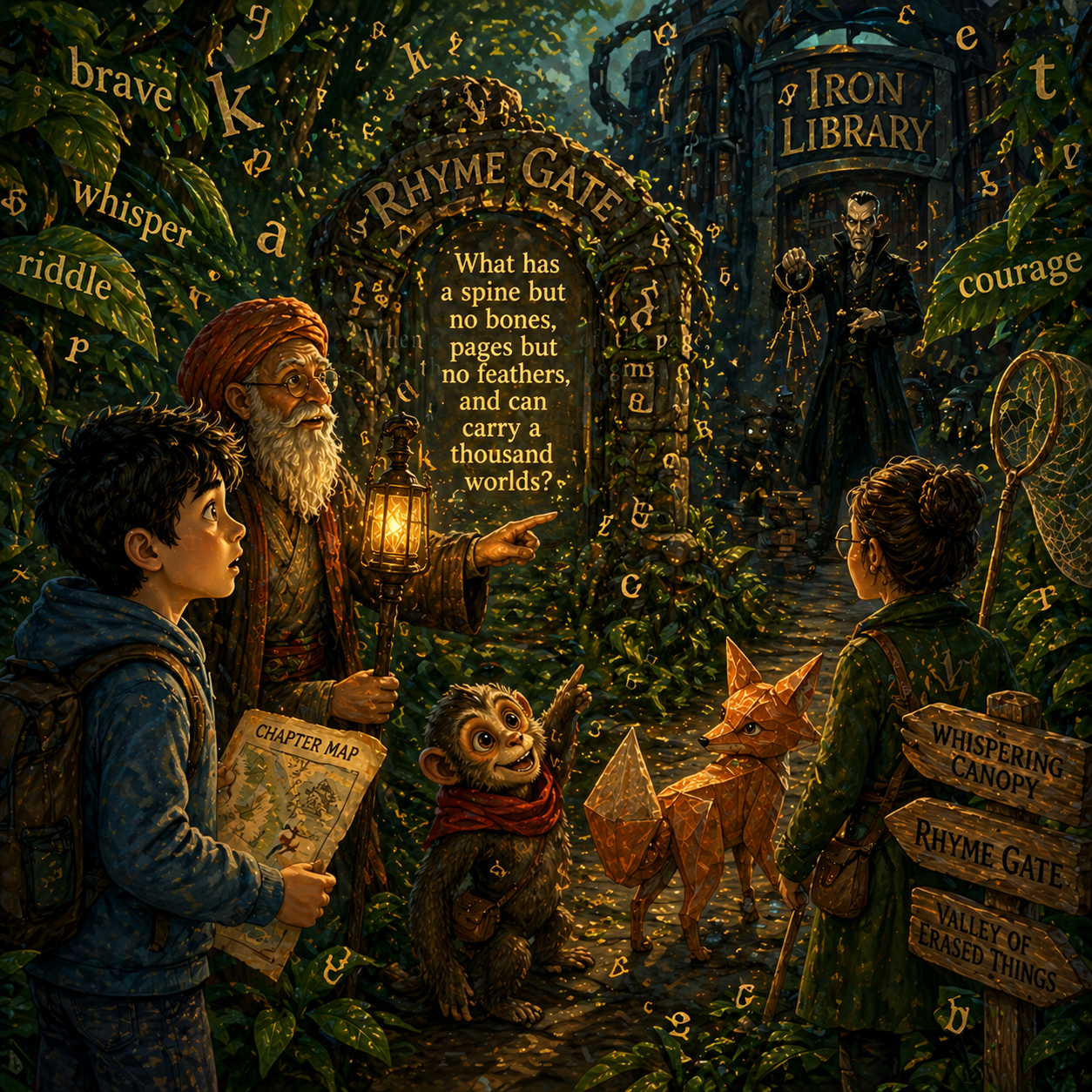
By dawn, they reached the Rhyme Gate: two tall stone pillars wound with ivy, standing in the middle of nowhere. Between them shimmered a silver barrier. A carved mouth appeared in one pillar and spoke in a bored voice.
“Answer three riddles. Fail, and you will be turned into footnotes.”
Spud swallowed.
The mouth asked, “What has a spine but no bones, pages but no feathers, and can carry a thousand worlds?”
“A book,” said Spud quickly.
The barrier flickered.
Second riddle. “What grows smaller each time you take from it?”
Talib frowned. Stitch sneezed a tiny paper scrap. Then Spud grinned.
“A hole,” he said.
The barrier glimmered brighter.
The third riddle took longer. “What belongs to the tale, yet cannot be found in ink, cannot be locked in a chest, and only appears when shared?”
Talib looked troubled. Miss Quill’s words came back to Spud: Readers are often useful in emergencies.
He thought about the stories he loved. About laughing at some, fearing others, remembering characters as if they were real people. He looked at the drifting barrier and answered, “Meaning.”
For a moment, nothing happened.
Then the silver barrier folded open like a curtain.
Talib stared at Spud with open admiration. “You may be the most alarming sort of person.”
“What sort is that?”
“The sort who understands things at the right moment.”
Beyond the gate lay the Valley of Erased Things. It was a grey place, quiet and sad. Broken towers stood half-faded. A wooden horse lay on its side beside a dried-up stream. Bits of lost stories drifted through the air like ash: a crown, a lantern, a name nobody remembered. Spud felt a tug of sorrow as they walked.
“What happened here?” he asked.
Talib’s voice softened. “Ideas that were abandoned. Tales never told. Endings thrown away.”
At the centre of the valley stood a boy no older than Spud. He was pale as paper and dressed in a coat stitched from scraps of blank parchment. His hands were stuffed in his pockets, and his expression was guarded.
“I know who you are,” he said. “You’re looking for the lost chapter.”
Talib stepped forward. “And you are?”
The boy shrugged. “Ink. That’s what I call myself.”
“Helpful,” said Talib.
Ink ignored him and turned to Spud. “The Binder has the chapter map, but not the chapter. I hid it.”
Spud was startled. “Why?”
Ink kicked a pebble. “Because every time a story ended, I disappeared. I was cut from a hundred drafts. Forgotten. Scrubbed out. If the missing chapter stayed missing, nothing could finish properly. Nothing would leave me behind.”
Talib’s stern expression softened a little.
Spud looked at the valley around them and understood. Ink was one of the erased things.
“You don’t have to vanish,” Spud said.
Ink laughed without humour. “That’s how stories work.”
“Only bad ones,” said Spud.
Ink looked up.
Spud went on. “If this book escaped because it lost its shape, maybe it doesn’t just need the missing chapter. Maybe it needs the right chapter. One that makes space for everyone who matters.”
Talib’s eyes widened, and Miss Quill, who had somehow appeared soundlessly behind them, gave a small approving nod.
Ink slowly took a folded sheet from inside his coat. It was not the chapter itself, but a map drawn in glowing ink. At its centre rose the Iron Library.
“The Binder is waiting,” Ink said. “He thinks I’ll come to bargain.”
“Then let’s disappoint him,” said Spud.
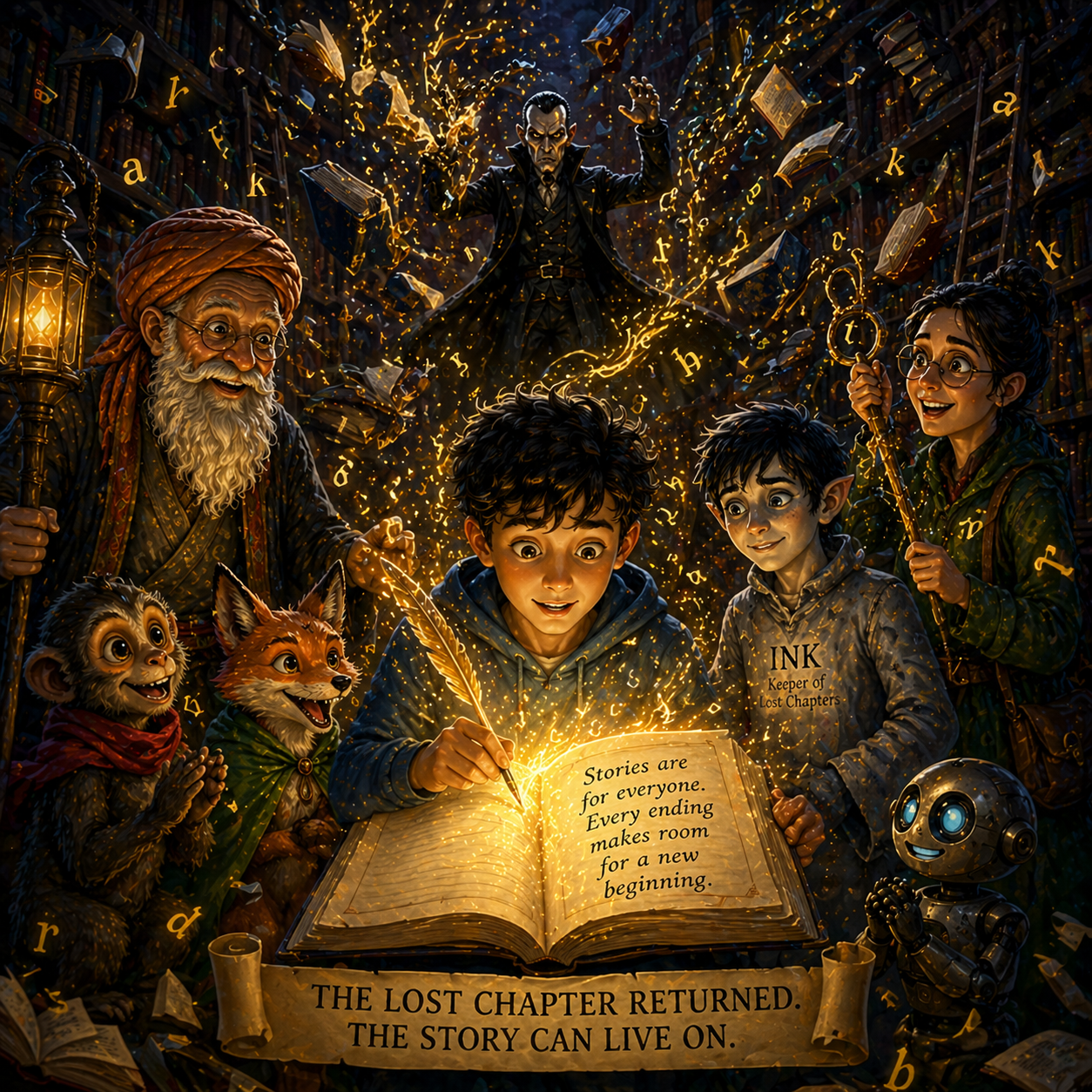
The Iron Library was immense, built of black metal shelves that climbed into darkness. Chains hung from the ceiling. Every book inside was locked shut. At the far end stood the Binder, tall and thin, in a coat as stiff as cardboard. He carried a silver key ring that clinked like cold rain.
“You are late,” he said.
“We got delayed by riddles,” Talib replied.
The Binder’s gaze fell on Spud. “A reader. Unfortunate. Readers are messy. They imagine things.”
“That is usually the point,” said Miss Quill.
The Binder ignored her. “Give me the chapter map, boy.”
Ink hesitated.
Spud stepped forward. “No.”
The Binder’s eyes narrowed. “No?”
“You want stories frozen,” Spud said. “Safe. Locked. Perfect. But stories aren’t meant to sit still. They change when people read them. They grow.”
“Chaos,” snapped the Binder.
“Life,” said Talib.
The chains above them rattled. Books trembled on the shelves. Spud felt words gathering around him, drawn from every locked volume in the room.
He understood then what the third riddle had meant. Meaning only appears when shared.
“Open the books!” Spud shouted.
Stitch leapt onto the Binder’s back, tangling him in his own chain of keys. Miss Quill swung her net and swept a ring of keys into the air. Talib caught them and flung them high. The keys burst into sparks. All at once, locks clicked open across the library.
Stories exploded into the room.
Clouds of bright sentences spiralled upward. Characters stepped from pages. A giant with a teacup helmet bellowed cheerfully. Tiny sailors sailed across the floor in a puddle of spilled ink. The room shook with voices, laughter, and music. The Binder staggered, helpless in the joyful disorder.
At the centre of the storm, the missing chapter appeared, floating in the air.
It was blank.
Everyone stared.
Spud looked at Talib. Talib looked at Spud. Slowly, the storyteller smiled.
“Of course,” he said. “It was never lost. It was waiting.”
“For what?” asked Ink.
“For the part that had not yet been written,” said Miss Quill.
The blank chapter drifted down into Spud’s hands. Letters began to rise from his skin like warm sparks. He did not think too hard. He simply wrote what he knew to be true.
He wrote that stories should have room for the forgotten.
He wrote that endings need not erase what came before.
He wrote that Ink, once abandoned, became Keeper of Lost Chapters, guiding unfinished tales to their proper homes.
As the final words appeared, the chapter slid into place inside The Story That Escaped. The Iron Library softened. The chains crumbled into dust. The Binder gave one last furious glare, then shrank into a neat little bookmark, which Stitch immediately sat on.
The jungle sighed with relief.
A moment later, Spud was back in his bedroom. Dawn light touched the curtains. The book lay closed on his lap. For a second, he wondered if he had dreamed everything.
Then he opened the front cover.
There, beneath the title, was a new line in silver letters:
Featuring a chapter by Spud.
And on the final page, in neat dark ink, were the words:
Some stories are not complete until a reader dares to enter them.
Tucked inside the back cover was a bookmark. It glared at him.
Spud smiled, placed it carefully on his shelf, and reached for a notebook.
He had the strange feeling this was not the last escaped story he would meet.
This page needs the StPageFlip script to load from the CDN. If you are using it offline, download the StPageFlip browser script and change the script link near the bottom of this file to use your local copy.